
Learning Objectives
By the end of this chapter, the student should be able to:
- define tamoxifen
- classify tamoxifen pharmacologically
- explain its mechanism of action
- describe its pharmacological effects
- discuss its therapeutic uses
- enumerate adverse effects, contraindications, and precautions
- differentiate tamoxifen from other anti-estrogenic drugs
- answer common viva and university examination questions on tamoxifen
1. Introduction
Tamoxifen is a selective estrogen receptor modulator (SERM). It acts as an anti-estrogen in some tissues and as a partial estrogen agonist in others. This tissue-selective action is the key to understanding both its therapeutic uses and its adverse effects.
Tamoxifen is one of the most important drugs in the pharmacology of hormone-dependent breast cancer, particularly estrogen receptor-positive (ER-positive) breast carcinoma. It occupies a central place in oncology, endocrine pharmacology, and gynecologic therapeutics.
For MBBS students, tamoxifen is a high-yield drug because it combines:
- receptor pharmacology
- endocrine therapy
- cancer chemotherapy
- adverse effects based on tissue-selective action
2. Classification
2.1 Pharmacological class
Tamoxifen belongs to the group of:
- selective estrogen receptor modulators (SERMs)
- anti-estrogenic agents used in hormone-responsive malignancy
2.2 Related drugs
Other SERMs include:
- Raloxifene
- Toremifene
- Clomiphene
- Bazedoxifene
2.3 Important distinction
Tamoxifen is not a pure estrogen antagonist. It behaves differently in different tissues:
- anti-estrogenic in breast
- partial estrogen agonist in bone
- partial estrogen agonist in endometrium
This point is extremely important for examinations.
3. Mechanism of Action
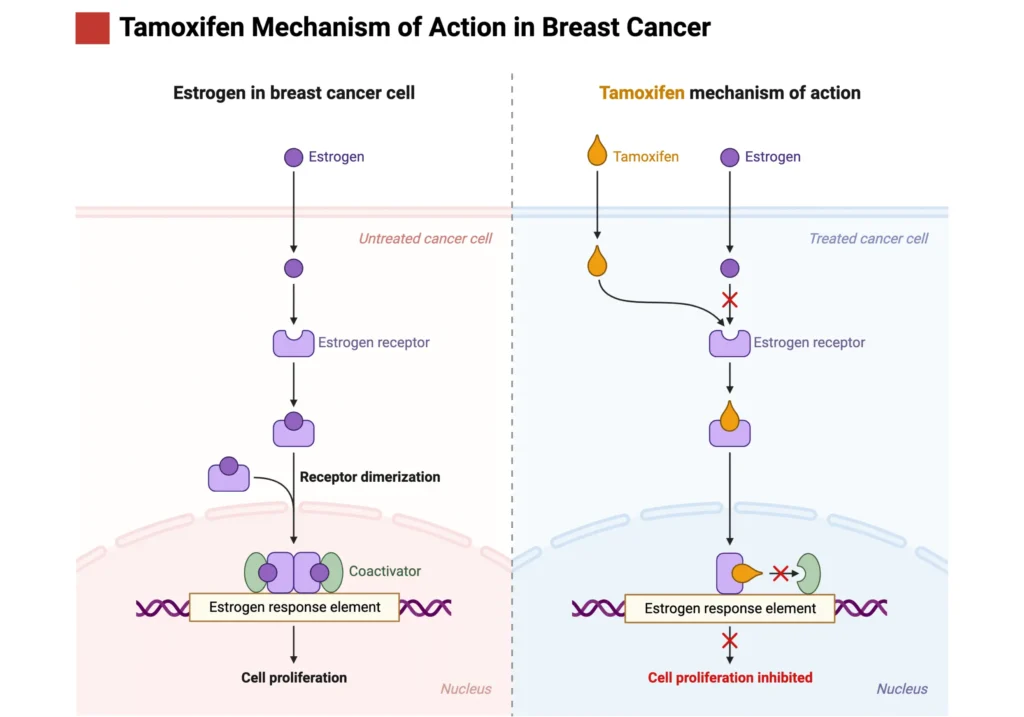
3.1 Basic mechanism
Tamoxifen binds to estrogen receptors (ERs) and blocks the action of estrogen in breast tissue. In ER-positive breast cancer cells, this prevents estrogen-driven transcriptional activity and inhibits growth of the tumor.
Thus, tamoxifen acts as a competitive antagonist of estrogen at breast receptors.
3.2 Tissue-selective action
The action of tamoxifen varies with tissue because the drug-receptor complex interacts differently with co-activators and co-repressors in different organs.
3.2.1 In breast
- anti-estrogenic action
- inhibits proliferation of ER-positive breast cancer cells
3.2.2 In bone
- estrogen-like action
- helps preserve bone mineral density
3.2.3 In endometrium
- partial estrogen agonist action
- may stimulate endometrial proliferation
This explains why tamoxifen can reduce bone loss but may increase the risk of endometrial hyperplasia and carcinoma.
3.3 Molecular effect
After binding to the estrogen receptor, tamoxifen alters receptor conformation and modifies gene transcription. The result is reduced expression of estrogen-dependent growth-promoting genes in breast tissue.
4. Pharmacological Actions
4.1 On breast tissue
Tamoxifen blocks the proliferative effects of estrogen on breast tissue. It is especially effective in ER-positive breast cancer.
4.1.1 Main effect
- inhibits growth of estrogen-dependent tumor cells
4.2 On endometrium
Tamoxifen has partial agonist action on the uterine endometrium.
4.2.1 Consequences
- endometrial proliferation
- increased risk of endometrial hyperplasia
- increased risk of endometrial carcinoma with long-term use
4.3 On bone
Tamoxifen has estrogen-like effects on bone and can reduce bone resorption.
4.3.1 Benefit
- may help maintain bone mineral density, especially in postmenopausal women
4.4 On lipid profile
Tamoxifen may have favorable effects on serum lipids.
4.4.1 Effect
- may reduce LDL cholesterol
However, this does not remove its other serious risks.
4.5 On hypothalamic-pituitary axis
Tamoxifen can interfere with estrogen feedback mechanisms. This endocrine effect is less emphasized clinically than its anticancer role, but it contributes to some hormonal manifestations.
5. Pharmacokinetics
5.1 Absorption
Tamoxifen is administered orally and is well absorbed.
5.2 Distribution
It is widely distributed in the body and is highly protein bound.
5.3 Metabolism
Tamoxifen is metabolized in the liver by cytochrome P450 enzymes into active metabolites, including:
- endoxifen
- 4-hydroxytamoxifen
These metabolites contribute significantly to the therapeutic action.
5.4 Elimination
Tamoxifen has a long half-life, and its metabolites may persist for a prolonged duration.
5.5 Clinical significance
Because metabolism is important for activation, variation in hepatic enzyme activity may affect therapeutic response.
6. Therapeutic Uses
6.1 Estrogen receptor-positive breast cancer
This is the most important indication.
Tamoxifen is used in:
- treatment of ER-positive breast cancer
- adjuvant therapy after surgery
- metastatic breast cancer in selected patients
6.1.1 Main role
- prevents estrogen-driven tumor growth
6.2 Prevention of recurrence
Tamoxifen is used after primary treatment of breast cancer to reduce the risk of recurrence.
6.3 Risk reduction in high-risk women
It may be used in selected women at high risk of breast cancer to reduce the chance of developing ER-positive disease.
6.4 Ductal carcinoma in situ
It may be used in selected cases after local treatment to reduce recurrence risk.
6.5 Male breast cancer
Tamoxifen may also be used in hormone receptor-positive male breast cancer.
7. Adverse Effects
The adverse effects of tamoxifen are very important because they arise directly from its mixed agonist-antagonist actions.
7.1 Common adverse effects
- hot flushes
- nausea
- vomiting
- menstrual irregularities
- vaginal discharge
- fatigue
7.2 Gynecological adverse effects
Because of estrogen-like action on endometrium, tamoxifen may cause:
- endometrial hyperplasia
- endometrial polyps
- endometrial carcinoma
- vaginal bleeding
7.2.1 Important clinical point
Any abnormal uterine bleeding in a patient taking tamoxifen should be evaluated carefully.
7.3 Thromboembolic complications
Tamoxifen increases the risk of:
- deep vein thrombosis
- pulmonary embolism
This is a major adverse effect.
7.4 Ocular effects
- cataract
- visual disturbances in some patients
7.5 Hepatic effects
Occasionally, liver dysfunction may occur.
7.6 Other adverse effects
- leg cramps
- edema
- headache
- mood changes in some patients
8. Contraindications
Tamoxifen is contraindicated or used with great caution in:
- history of thromboembolic disease
- pregnancy
- known hypersensitivity
- severe unexplained vaginal bleeding unless evaluated
- active endometrial malignancy, depending on clinical context and specialist judgment
9. Precautions
9.1 In women with uterine symptoms
Careful gynecological evaluation is needed if there is:
- vaginal bleeding
- pelvic pain
- abnormal discharge
9.2 In patients at risk of thrombosis
Use cautiously in patients with:
- previous DVT
- pulmonary embolism
- prolonged immobilization
9.3 In liver disease
Caution is advised because tamoxifen is metabolized in the liver.
9.4 In premenopausal women
Menstrual changes and ovarian stimulation-related effects may occur.
10. Drug Interactions
10.1 With enzyme inhibitors
Drugs that inhibit hepatic enzymes involved in tamoxifen metabolism may reduce formation of active metabolites and reduce efficacy.
10.2 With anticoagulants
Tamoxifen may enhance anticoagulant effects in some situations and requires caution.
10.3 With other hormonal agents
Concomitant use of some hormonal therapies may modify the therapeutic response.
11. Tamoxifen versus Other Endocrine Drugs
11.1 Tamoxifen versus raloxifene
| Feature | Tamoxifen | Raloxifene |
|---|---|---|
| Class | SERM | SERM |
| Action in breast | anti-estrogenic | anti-estrogenic |
| Action on bone | estrogen-like | estrogen-like |
| Action on endometrium | partial agonist | minimal agonist effect |
| Risk of endometrial carcinoma | increased | much lower |
| Main use | breast cancer | osteoporosis, risk reduction in selected women |
11.1.1 Important point
Raloxifene is less associated with endometrial stimulation than tamoxifen.
11.2 Tamoxifen versus aromatase inhibitors
| Feature | Tamoxifen | Aromatase inhibitors |
|---|---|---|
| Mechanism | blocks estrogen receptor in breast | reduces estrogen synthesis |
| Best known use | ER-positive breast cancer | especially postmenopausal ER-positive breast cancer |
| Bone effect | relatively protective | may worsen bone loss |
| Endometrial risk | increased | no agonist endometrial effect |
Examples of aromatase inhibitors:
- Anastrozole
- Letrozole
- Exemestane
11.3 Tamoxifen versus fulvestrant
| Feature | Tamoxifen | Fulvestrant |
|---|---|---|
| Type | SERM | pure estrogen receptor antagonist / down-regulator |
| Agonist effect in endometrium | yes | no |
| Breast effect | anti-estrogenic | anti-estrogenic |
12. Summary Table of Tamoxifen
| Parameter | Description |
|---|---|
| Class | selective estrogen receptor modulator |
| Main action in breast | anti-estrogenic |
| Action in bone | partial estrogen agonist |
| Action in endometrium | partial estrogen agonist |
| Main use | ER-positive breast cancer |
| Major adverse effects | hot flushes, thromboembolism, endometrial carcinoma |
| Route | oral |
| Important warning | abnormal uterine bleeding requires evaluation |
13. Tamoxifen in Special Clinical Situations
13.1 In premenopausal women
Tamoxifen is commonly used in premenopausal women with ER-positive breast cancer.
13.2 In postmenopausal women
It is also useful, though aromatase inhibitors are often important alternatives in many cases.
13.3 In pregnancy
Tamoxifen is generally avoided because of potential fetal harm.
13.4 In patients with thrombotic risk
Use must be cautious because tamoxifen can increase thromboembolic complications.
14. Mnemonics
14.1 Main identity of tamoxifen
“TAMes estrogen in the Mammary gland.”
Tamoxifen acts mainly as an anti-estrogen in breast tissue.
14.2 Tissue-selective action
“TAM blocks Breast, but Backs Bone and Uterus.”
- blocks breast
- supports bone
- stimulates uterus
This mnemonic helps remember why it is useful in breast cancer but risky for the endometrium.
14.3 Major adverse effects
“TAM = Thrombosis And Malignancy of endometrium.”
- thrombosis
- endometrial carcinoma risk
14.4 Use in breast cancer
“Tamoxifen targets tumors that trust estrogen.”
It is useful in ER-positive tumors.
15. High-Yield Exam Points
- Tamoxifen is a selective estrogen receptor modulator.
- It is anti-estrogenic in breast and estrogen-like in bone and endometrium.
- It is used mainly in ER-positive breast cancer.
- It may reduce recurrence after primary treatment.
- It increases the risk of endometrial hyperplasia and carcinoma.
- It increases the risk of thromboembolic events.
- It is given orally.
- Abnormal uterine bleeding during therapy must be investigated.
- Tamoxifen differs from raloxifene because tamoxifen stimulates the endometrium more.
- Tamoxifen differs from aromatase inhibitors because it blocks receptors rather than estrogen synthesis.
16. Viva Questions and Answers
16.1 Short viva questions
1. What is tamoxifen?
Tamoxifen is a selective estrogen receptor modulator used mainly in estrogen receptor-positive breast cancer.
2. What is the class of tamoxifen?
Selective estrogen receptor modulator.
3. What is the main mechanism of tamoxifen in breast cancer?
It blocks estrogen receptors in breast tissue and inhibits growth of ER-positive tumor cells.
4. Is tamoxifen a pure estrogen antagonist?
No. It is tissue-selective and acts as a partial agonist in some tissues.
5. Where is tamoxifen anti-estrogenic?
In breast tissue.
6. Where does tamoxifen show estrogen-like effects?
In bone and endometrium.
7. What is the main therapeutic use of tamoxifen?
ER-positive breast cancer.
8. What is a major gynecological adverse effect of tamoxifen?
Endometrial hyperplasia or endometrial carcinoma.
9. What is a major vascular adverse effect of tamoxifen?
Thromboembolism.
10. Why should abnormal uterine bleeding be investigated in a patient taking tamoxifen?
Because tamoxifen can stimulate the endometrium and increase the risk of endometrial pathology.
11. Give one example of another SERM.
Raloxifene.
12. How does tamoxifen differ from aromatase inhibitors?
Tamoxifen blocks estrogen receptors, while aromatase inhibitors reduce estrogen synthesis.
16.2 Long viva questions
1. Write a detailed note on tamoxifen.
2. Explain the mechanism of action, uses, and adverse effects of tamoxifen.
3. Why is tamoxifen called a selective estrogen receptor modulator?
4. Compare tamoxifen with raloxifene.
5. Compare tamoxifen with aromatase inhibitors.
17. Short Notes for University Examinations
17.1 Short note: Tamoxifen
Tamoxifen is a selective estrogen receptor modulator that acts as an anti-estrogen in breast tissue and a partial estrogen agonist in bone and endometrium. It is used mainly in estrogen receptor-positive breast cancer for treatment and prevention of recurrence. Major adverse effects include hot flushes, thromboembolism, endometrial hyperplasia, and endometrial carcinoma.
17.2 Short note: SERMs
Selective estrogen receptor modulators are drugs that act as estrogen antagonists in some tissues and agonists in others. Tamoxifen and raloxifene are important examples. Tamoxifen is used mainly in breast cancer, whereas raloxifene is commonly used in osteoporosis and breast cancer risk reduction in selected women.
17.3 Short note: Adverse effects of tamoxifen
Important adverse effects of tamoxifen include hot flushes, nausea, vaginal bleeding, thromboembolic events, endometrial hyperplasia, and endometrial carcinoma. Because of endometrial stimulation, abnormal uterine bleeding during treatment requires investigation.
18. One-Page Revision Table
| Topic | Key Point |
|---|---|
| Drug class | SERM |
| Breast action | anti-estrogenic |
| Bone action | estrogen-like |
| Endometrial action | estrogen-like |
| Main use | ER-positive breast cancer |
| Major vascular risk | DVT / pulmonary embolism |
| Major gynecologic risk | endometrial carcinoma |
| Route | oral |
| Important symptom to investigate | abnormal uterine bleeding |
19. Conclusion
Tamoxifen is a classic example of a drug whose benefits and adverse effects are both explained by receptor pharmacology. As a selective estrogen receptor modulator, it blocks estrogen action in breast tissue while producing estrogen-like effects in bone and endometrium. This makes it highly valuable in ER-positive breast cancer, yet responsible for important risks such as thromboembolism and endometrial carcinoma. A clear understanding of tamoxifen is essential for MBBS students because it is one of the best examples of tissue-selective drug action in clinical pharmacology.
20. Rapid Recall Box
- Tamoxifen → SERM
- Breast → anti-estrogenic
- Bone → estrogen-like
- Endometrium → estrogen-like
- Main use → ER-positive breast cancer
- Major adverse effects → hot flushes, thrombosis, endometrial carcinoma
- Route → oral
- Key warning → investigate abnormal uterine bleeding
Medical Disclaimer
The medical information on this post is for general educational purposes only and is provided by Pharmacology Mentor. While we strive to keep content current and accurate, Pharmacology Mentor makes no representations or warranties, express or implied, regarding the completeness, accuracy, reliability, suitability, or availability of the post, the website, or any information, products, services, or related graphics for any purpose. This content is not a substitute for professional medical advice, diagnosis, or treatment; always seek the advice of your physician or other qualified health provider with any questions you may have regarding a medical condition and never disregard or delay seeking professional advice because of something you have read here. Reliance on any information provided is solely at your own risk.
Community Notes
Join the Discussion
Ask follow-up questions, add clinical perspective, or share a useful clarification for the next reader.