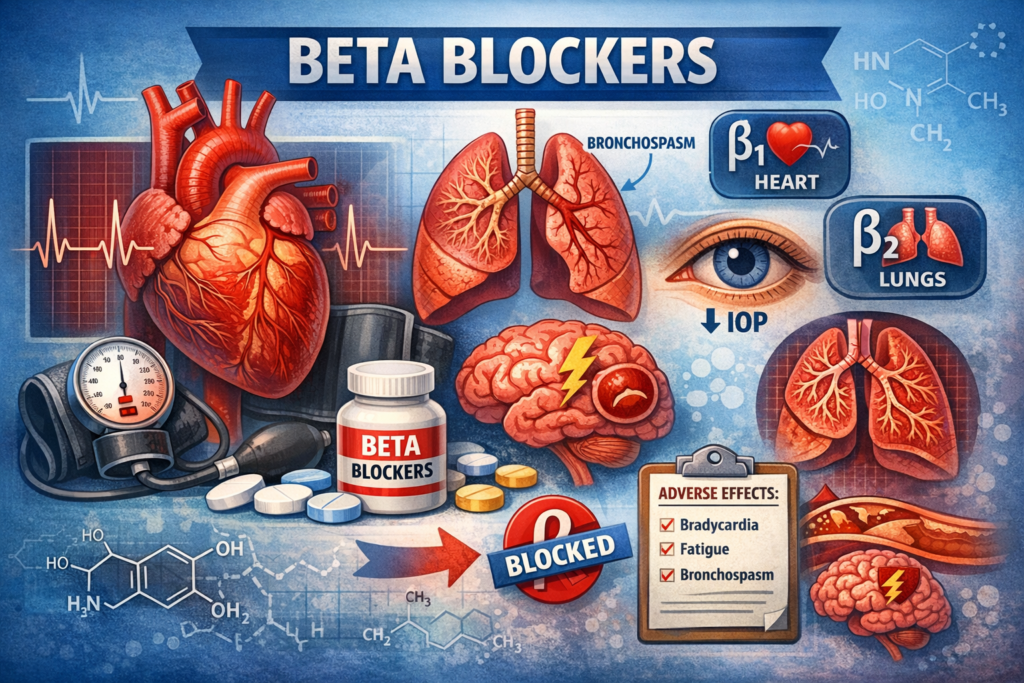
Learning Objectives
By the end of this chapter, the student should be able to:
- define beta blockers
- classify beta blockers
- explain the mechanism of action of beta blockers
- describe the pharmacological effects on various organ systems
- discuss therapeutic uses, adverse effects, contraindications, and precautions
- differentiate selective and non-selective beta blockers
- answer common viva and theory questions on beta blockers
1. Introduction
Beta blockers, also called β-adrenergic antagonists or β-adrenoceptor blockers, are drugs that block the actions of catecholamines such as adrenaline and noradrenaline on beta-adrenergic receptors.
They are among the most important drugs in cardiovascular pharmacology and are widely used in:
- hypertension
- angina pectoris
- myocardial infarction
- arrhythmias
- heart failure
- glaucoma
- thyrotoxicosis
- migraine prophylaxis
- essential tremor
- portal hypertension
Beta blockers are high-yield drugs in MBBS because they connect autonomic pharmacology with cardiology, medicine, ophthalmology, and endocrinology.
2. Adrenergic Receptors Relevant to Beta Blockers
2.1 Beta-1 receptors
Located predominantly in:
- heart
- juxtaglomerular cells of kidney
2.1.1 Stimulation causes
- increased heart rate
- increased force of contraction
- increased AV conduction
- increased renin release
2.2 Beta-2 receptors
Located predominantly in:
- bronchial smooth muscle
- vascular smooth muscle
- uterus
- liver
- skeletal muscle
2.2.1 Stimulation causes
- bronchodilation
- vasodilation
- uterine relaxation
- glycogenolysis
- tremor
2.3 Beta-3 receptors
Located mainly in:
- adipose tissue
- urinary bladder
These are less important in classical MBBS discussions of beta blockers.
3. Definition
Beta blockers are drugs that competitively antagonize beta-adrenergic receptors, thereby reducing the effects of sympathetic stimulation on target organs.
4. Classification of Beta Blockers
Beta blockers may be classified in several ways.
4.1 According to receptor selectivity
4.1.1 Non-selective beta blockers
Block both β1 and β2 receptors.
Examples:
- Propranolol
- Nadolol
- Timolol
- Pindolol
4.1.2 Cardioselective beta blockers
Preferentially block β1 receptors.
Examples:
- Atenolol
- Metoprolol
- Bisoprolol
- Esmolol
- Betaxolol
- Nebivolol
4.2 According to presence of intrinsic sympathomimetic activity (ISA)
These drugs partially stimulate beta receptors while blocking stronger catecholamine effects.
Examples:
- Pindolol
- Acebutolol
They are less commonly emphasized in routine clinical use today.
4.3 According to additional vasodilator action
Examples:
- Carvedilol → also blocks α1 receptors
- Labetalol → blocks β and α1 receptors
- Nebivolol → enhances nitric oxide-mediated vasodilation
4.4 According to lipid solubility
4.4.1 Highly lipid-soluble
- Propranolol
- Metoprolol
4.4.2 Less lipid-soluble / hydrophilic
- Atenolol
This affects CNS penetration and pharmacokinetics.
5. Classification Table
| Class | Drugs | Main Feature |
|---|---|---|
| Non-selective | Propranolol, Timolol, Nadolol, Pindolol | block β1 and β2 |
| β1-selective | Atenolol, Metoprolol, Bisoprolol, Esmolol, Betaxolol, Nebivolol | mainly block β1 |
| With ISA | Pindolol, Acebutolol | partial agonist property |
| Mixed α + β blockers | Labetalol, Carvedilol | vasodilator effect also |
| Ultra-short acting | Esmolol | very short duration |
6. Mechanism of Action
Beta blockers competitively inhibit catecholamines at beta receptors.
6.1 In the heart
Blocking β1 receptors produces:
- decreased heart rate (negative chronotropic effect)
- decreased force of contraction (negative inotropic effect)
- decreased AV conduction (negative dromotropic effect)
- reduced cardiac output
6.2 In the kidney
Blocking β1 receptors in juxtaglomerular cells reduces:
- renin secretion
- angiotensin II formation
- aldosterone secretion indirectly
This contributes to the antihypertensive action.
6.3 In the eye
Beta blockers reduce aqueous humor production, lowering intraocular pressure.
6.4 In other tissues
Non-selective beta blockers can block β2 receptors and produce:
- bronchoconstriction
- peripheral vasoconstriction in some patients
- impaired glycogenolysis
- masking of hypoglycemia
7. Pharmacological Actions
7.1 Cardiovascular system
This is the most important section.
7.1.1 Effects
- decrease heart rate
- decrease myocardial contractility
- decrease cardiac output
- decrease blood pressure
- reduce myocardial oxygen demand
- suppress arrhythmias
- reduce renin release
7.1.2 Clinical significance
These effects explain use in:
- hypertension
- angina
- arrhythmias
- post-myocardial infarction states
- chronic heart failure
7.2 Blood pressure
Beta blockers lower blood pressure by:
- reducing cardiac output
- inhibiting renin release
- decreasing sympathetic outflow in some cases
Initially, peripheral resistance may not fall much, but with long-term use BP decreases.
7.3 Respiratory system
Non-selective beta blockers block β2 receptors in bronchi, causing:
- bronchoconstriction
- increased airway resistance
7.3.1 Important point
This is why non-selective beta blockers are contraindicated in bronchial asthma.
7.4 Eye
Beta blockers such as timolol decrease aqueous humor formation and lower intraocular pressure.
7.4.1 Use
- glaucoma
7.5 CNS
Especially lipid-soluble beta blockers may cause:
- sedation
- fatigue
- depression
- nightmares
- sleep disturbance
Propranolol crosses the blood-brain barrier relatively well.
7.6 Metabolic effects
Non-selective beta blockers may:
- inhibit glycogenolysis
- prolong recovery from hypoglycemia
- mask adrenergic warning signs of hypoglycemia such as tachycardia and tremor
- alter lipid profile slightly in some cases
This is important in diabetic patients.
7.7 Skeletal muscle
Beta blockers may reduce:
- tremors
Hence propranolol is useful in essential tremor and in tremor associated with anxiety or thyrotoxicosis.
8. Pharmacokinetics
8.1 Absorption
Most beta blockers are well absorbed orally.
8.2 First-pass metabolism
Some drugs like propranolol undergo significant first-pass metabolism.
8.3 Distribution
Lipid-soluble drugs enter the CNS more easily.
8.4 Elimination
- Atenolol is mainly renally excreted
- Propranolol is mainly hepatically metabolized
- Esmolol is rapidly metabolized by esterases in red blood cells
8.5 Duration
- Esmolol is ultra-short acting
- Atenolol and nadolol have longer duration
9. Therapeutic Uses of Beta Blockers
9.1 Hypertension
Beta blockers reduce blood pressure mainly by:
- decreasing cardiac output
- decreasing renin release
They are especially useful when hypertension is associated with:
- angina
- previous myocardial infarction
- tachyarrhythmia
- heart failure
9.2 Angina pectoris
Beta blockers reduce:
- heart rate
- contractility
- blood pressure
Thus they reduce myocardial oxygen demand, making them useful in chronic stable angina.
9.2.1 Important note
They are not first choice in vasospastic angina, where they may worsen spasm.
9.3 Myocardial infarction
Beta blockers are useful:
- during and after MI in selected patients
- for secondary prevention after MI
9.3.1 Benefits
- reduce arrhythmias
- reduce myocardial oxygen demand
- improve survival in appropriate patients
9.4 Cardiac arrhythmias
Useful particularly in:
- supraventricular tachycardia
- atrial fibrillation rate control
- atrial flutter rate control
- some ventricular arrhythmias
- arrhythmias due to catecholamine excess
9.4.1 Examples
- Metoprolol
- Esmolol
- Propranolol
9.5 Chronic heart failure
Certain beta blockers improve survival in chronic heart failure when carefully introduced.
9.5.1 Important drugs
- Metoprolol
- Bisoprolol
- Carvedilol
9.5.2 Important exam point
Although beta blockers reduce cardiac contractility acutely, long-term controlled use improves outcomes in chronic heart failure.
9.6 Glaucoma
Topical beta blockers such as timolol reduce intraocular pressure by decreasing aqueous humor secretion.
9.7 Thyrotoxicosis
Propranolol is useful because it:
- relieves tachycardia, tremor, anxiety
- partially inhibits peripheral conversion of T4 to T3 at high doses
9.8 Migraine prophylaxis
Beta blockers, especially propranolol, are used to prevent recurrent migraine attacks.
9.9 Essential tremor
Propranolol reduces tremor amplitude.
9.10 Performance anxiety
Propranolol may be used to reduce autonomic symptoms such as:
- tachycardia
- tremor
- palpitations
9.11 Pheochromocytoma
Beta blockers may be used only after adequate alpha blockade to control tachycardia.
9.11.1 Important point
Never give beta blocker alone before alpha blockade in pheochromocytoma, because unopposed alpha stimulation may cause severe hypertension.
9.12 Portal hypertension
Non-selective beta blockers such as propranolol may reduce portal pressure and are used in prevention of variceal bleeding.
10. Summary Table of Therapeutic Uses
| Use | Common Drugs |
|---|---|
| Hypertension | Atenolol, Metoprolol, Bisoprolol, Labetalol |
| Angina | Propranolol, Atenolol, Metoprolol |
| Post-MI | Metoprolol, Propranolol, Bisoprolol |
| Arrhythmias | Esmolol, Metoprolol, Propranolol |
| Heart failure | Bisoprolol, Metoprolol, Carvedilol |
| Glaucoma | Timolol, Betaxolol |
| Thyrotoxicosis | Propranolol |
| Migraine prophylaxis | Propranolol |
| Essential tremor | Propranolol |
| Portal hypertension | Propranolol, Nadolol |
| Hypertensive emergencies in pregnancy | Labetalol |
11. Adverse Effects of Beta Blockers
11.1 Common adverse effects
- bradycardia
- hypotension
- fatigue
- weakness
- cold extremities
- dizziness
- exercise intolerance
11.2 Cardiovascular adverse effects
- excessive bradycardia
- AV block
- worsening of acute heart failure
- severe hypotension
11.3 Respiratory adverse effects
Especially with non-selective drugs:
- bronchospasm
- aggravation of asthma
11.4 CNS adverse effects
More common with lipid-soluble drugs:
- depression
- nightmares
- sleep disturbances
- mental fatigue
11.5 Metabolic adverse effects
- masking of hypoglycemia
- delayed recovery from hypoglycemia
- possible adverse lipid changes
11.6 Sexual dysfunction
May occur in some patients.
12. Contraindications
Beta blockers are contraindicated or used with extreme caution in:
- bronchial asthma
- severe bradycardia
- AV block
- cardiogenic shock
- acute decompensated heart failure
- severe peripheral vascular disease
- variant angina in some settings
- uncontrolled diabetes with frequent hypoglycemia, with caution rather than absolute contraindication
13. Precautions
Use carefully in:
- diabetes mellitus
- COPD/asthma
- peripheral vascular disease
- depression
- elderly patients
- liver or kidney disease depending on the drug
14. Abrupt Withdrawal
A very important exam point.
Sudden withdrawal of beta blockers may cause:
- rebound tachycardia
- worsening angina
- arrhythmias
- myocardial infarction in high-risk patients
14.1 Reason
Chronic beta blockade may cause receptor upregulation; abrupt stoppage exposes the heart to catecholamine excess.
14.2 Rule
Beta blockers should be tapered gradually, not stopped abruptly.
15. Drug Interactions
15.1 With verapamil or diltiazem
May cause:
- marked bradycardia
- AV block
- heart failure
15.2 With insulin or oral antidiabetic drugs
May mask hypoglycemia.
15.3 With other antihypertensives
May cause additive hypotension.
15.4 With digoxin
Risk of excessive bradycardia or AV conduction problems may increase.
15.5 In pheochromocytoma
Beta blocker should not be given before alpha blockade.
16. Comparison of Important Beta Blockers
| Drug | Selectivity | Special Feature | Main Uses |
|---|---|---|---|
| Propranolol | non-selective | highly lipid-soluble | angina, migraine, tremor, thyrotoxicosis |
| Atenolol | β1-selective | hydrophilic, longer acting | hypertension, angina |
| Metoprolol | β1-selective | commonly used in CV disease | HTN, angina, MI, HF |
| Bisoprolol | β1-selective | important in heart failure | HTN, HF |
| Esmolol | β1-selective | ultra-short acting IV | acute arrhythmias, perioperative control |
| Timolol | non-selective | topical use in eye | glaucoma |
| Carvedilol | non-selective + α1 block | vasodilator | heart failure, hypertension |
| Labetalol | non-selective + α1 block | useful in hypertensive emergencies | HTN, pregnancy HTN |
| Nebivolol | β1-selective | nitric oxide-mediated vasodilation | hypertension |
17. Selective vs Non-Selective Beta Blockers
| Feature | β1-selective | Non-selective |
|---|---|---|
| Receptors blocked | mainly β1 | β1 and β2 |
| Bronchospasm risk | lower | higher |
| Use in asthma | relatively safer, but still cautious | generally avoided |
| Examples | Atenolol, Metoprolol, Bisoprolol | Propranolol, Timolol, Nadolol |
17.1 Important note
Selectivity is dose-dependent. At high doses, even β1-selective drugs may block β2 receptors.
18. Beta Blockers with ISA
Some beta blockers have partial agonist activity.
Examples:
- Pindolol
- Acebutolol
18.1 Effects
- less resting bradycardia
- less reduction in cardiac output at rest
18.2 Clinical note
They are not commonly preferred after MI.
19. Beta Blockers in Special Conditions
19.1 In asthma
Avoid non-selective beta blockers.
19.2 In diabetes
Can mask tachycardia and tremor due to hypoglycemia.
19.3 In heart failure
Useful only selected agents and only under careful supervision.
19.4 In pregnancy
Labetalol is commonly used in hypertensive disorders of pregnancy.
20. Mnemonics
20.1 Main action of beta blockers
“Beta blockers bring the beat below.”
They reduce heart rate and cardiac workload.
20.2 Non-selective example
“Propranolol is Pro at blocking both.”
Blocks both β1 and β2.
20.3 β1-selective drugs
“A-M-BE-N are heart-friendly”
- Atenolol
- Metoprolol
- Bisoprolol
- Esmolol
- Nebivolol
20.4 Glaucoma drug
“TIME lowers eye pressure”
- TIMolol in the EYE
20.5 Contraindication
“Beta block the bronchi too”
Think asthma with non-selective drugs.
20.6 Special uses of propranolol
“Propranolol Protects in Pressure, Pulse, Panic, and Prophylaxis”
- blood pressure
- pulse control
- performance anxiety
- migraine prophylaxis
21. High-Yield Exam Points
- Beta blockers are competitive antagonists at beta receptors.
- β1 blockade decreases heart rate, force, AV conduction, and renin release.
- Non-selective beta blockers can cause bronchospasm.
- Propranolol is a non-selective beta blocker.
- Atenolol and metoprolol are β1-selective.
- Esmolol is ultra-short acting.
- Timolol is used topically in glaucoma.
- Propranolol is useful in thyrotoxicosis, essential tremor, and migraine prophylaxis.
- Certain beta blockers improve survival in chronic heart failure.
- Beta blockers should not be stopped abruptly.
- In pheochromocytoma, beta blockade should only follow alpha blockade.
22. Viva Questions and Answers
22.1 Short viva questions
1. What are beta blockers?
They are drugs that block beta-adrenergic receptors and inhibit the effects of catecholamines.
2. Name one non-selective beta blocker.
Propranolol.
3. Name two cardioselective beta blockers.
Atenolol and metoprolol.
4. What is the effect of β1 blockade on the heart?
Decreased heart rate, contractility, and conduction.
5. How do beta blockers lower blood pressure?
By reducing cardiac output and suppressing renin release.
6. Why are non-selective beta blockers contraindicated in asthma?
Because they block β2 receptors and cause bronchoconstriction.
7. Which beta blocker is used in glaucoma?
Timolol.
8. Which beta blocker is ultra-short acting?
Esmolol.
9. Which beta blocker is used in thyrotoxicosis?
Propranolol.
10. Which beta blocker is useful in chronic heart failure?
Bisoprolol, metoprolol, or carvedilol.
11. Why should beta blockers not be stopped abruptly?
Because abrupt withdrawal can cause rebound tachycardia, angina, and arrhythmias.
12. Which beta blocker is commonly used in hypertensive disorders of pregnancy?
Labetalol.
13. What is ISA?
Intrinsic sympathomimetic activity.
14. Name one beta blocker with ISA.
Pindolol.
15. Why should beta blockers be used cautiously in diabetes?
They may mask symptoms of hypoglycemia.
22.2 Long viva questions
1. Classify beta blockers and describe their mechanism of action.
2. Write a detailed note on propranolol.
3. Discuss the pharmacological actions and therapeutic uses of beta blockers.
4. Compare selective and non-selective beta blockers.
5. Write the adverse effects and contraindications of beta blockers.
23. Short Notes for University Exams
23.1 Short note: Propranolol
Propranolol is a non-selective beta blocker that blocks both β1 and β2 receptors. It decreases heart rate, myocardial contractility, AV conduction, and renin release. It is used in hypertension, angina, arrhythmias, thyrotoxicosis, migraine prophylaxis, and essential tremor. Adverse effects include bradycardia, bronchospasm, fatigue, and CNS effects. It is contraindicated in asthma.
23.2 Short note: Cardioselective beta blockers
Cardioselective beta blockers preferentially block β1 receptors in the heart. Examples include atenolol, metoprolol, bisoprolol, and esmolol. They are mainly used in cardiovascular diseases and are relatively safer than non-selective drugs in patients with airway disease, though caution is still needed.
23.3 Short note: Timolol
Timolol is a non-selective beta blocker used topically in glaucoma. It lowers intraocular pressure by decreasing aqueous humor production. It can still be systemically absorbed and may cause bradycardia or bronchospasm.
24. One-Page Revision Table
| Topic | Key Point |
|---|---|
| Main action | block beta receptors |
| β1 effect | ↓ HR, ↓ contractility, ↓ renin |
| Non-selective example | propranolol |
| β1-selective examples | atenolol, metoprolol, bisoprolol |
| Ultra-short acting | esmolol |
| Eye use | timolol in glaucoma |
| HF drugs | metoprolol, bisoprolol, carvedilol |
| Thyrotoxicosis drug | propranolol |
| Main danger in asthma | bronchospasm |
| Withdrawal | taper gradually |
25. Conclusion
Beta blockers are among the most important drugs in clinical pharmacology. Their principal action is blockade of beta-adrenergic receptors, especially β1 receptors in the heart and kidney. This produces beneficial effects in hypertension, angina, arrhythmias, myocardial infarction, and heart failure. However, their use requires care because they may cause bradycardia, bronchospasm, and metabolic disturbances. A strong understanding of their classification, mechanisms, uses, and contraindications is essential for MBBS students.
26. Rapid Recall Box
- Beta blockers → block beta receptors
- β1 blockade → ↓ HR, ↓ force, ↓ renin
- Propranolol → non-selective
- Atenolol / Metoprolol / Bisoprolol → β1-selective
- Esmolol → ultra-short acting
- Timolol → glaucoma
- Carvedilol / Labetalol → α + β blockers
- Main adverse effects → bradycardia, bronchospasm, fatigue
- Never stop abruptly
Medical Disclaimer
The medical information on this post is for general educational purposes only and is provided by Pharmacology Mentor. While we strive to keep content current and accurate, Pharmacology Mentor makes no representations or warranties, express or implied, regarding the completeness, accuracy, reliability, suitability, or availability of the post, the website, or any information, products, services, or related graphics for any purpose. This content is not a substitute for professional medical advice, diagnosis, or treatment; always seek the advice of your physician or other qualified health provider with any questions you may have regarding a medical condition and never disregard or delay seeking professional advice because of something you have read here. Reliance on any information provided is solely at your own risk.
Community Notes
Join the Discussion
Ask follow-up questions, add clinical perspective, or share a useful clarification for the next reader.