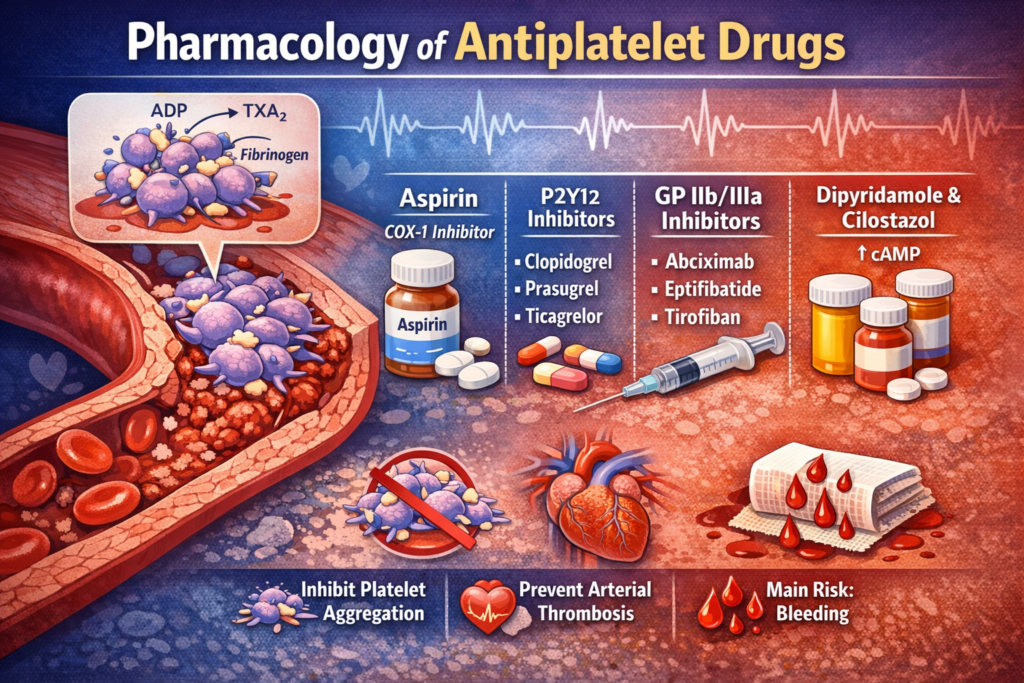
Learning Objectives
By the end of this chapter, the student should be able to:
- define antiplatelet drugs
- explain the physiology of platelet activation and aggregation
- classify antiplatelet drugs
- describe the mechanism of action of major antiplatelet agents
- discuss their pharmacological actions, therapeutic uses, adverse effects, and contraindications
- distinguish antiplatelet drugs from anticoagulants
- answer common viva and theory questions on the topic
1. Introduction
Antiplatelet drugs are agents that inhibit platelet activation, adhesion, or aggregation, thereby preventing formation of platelet-rich arterial thrombi.
These drugs are especially important in diseases where platelet aggregation is central to pathogenesis, such as:
- myocardial infarction
- unstable angina
- ischemic stroke
- transient ischemic attack
- peripheral arterial disease
- post-coronary angioplasty and stenting
They are among the most frequently prescribed drugs in cardiovascular and cerebrovascular medicine.
2. Physiological Basis of Platelet Aggregation
To understand antiplatelet drugs, one must first understand how platelets participate in hemostasis.
2.1 Steps in platelet plug formation
When the endothelium is damaged:
- Platelet adhesion occurs at the site of injury
- mediated by von Willebrand factor
- platelets adhere to exposed collagen
- Platelet activation occurs
- platelets change shape
- granule contents are released
- Release of mediators
Activated platelets release:- ADP
- serotonin
- thromboxane A₂ (TXA₂)
- Platelet aggregation
- GP IIb/IIIa receptors are activated
- fibrinogen binds adjacent platelets together
- platelet plug is formed
2.2 Important mediators
| Mediator | Action |
|---|---|
| ADP | promotes platelet activation and aggregation |
| Thromboxane A₂ | causes platelet aggregation and vasoconstriction |
| Prostacyclin (PGI₂) | inhibits platelet aggregation and causes vasodilation |
| Nitric oxide | inhibits platelet activation |
| Thrombin | strong platelet activator |
| GP IIb/IIIa receptor | final receptor mediating platelet aggregation via fibrinogen binding |
3. Definition and General Features
Antiplatelet drugs are used primarily to prevent arterial thrombosis, because arterial thrombi are rich in platelets.
This is in contrast to venous thrombi, which are more fibrin-rich and are more effectively treated with anticoagulants.
4. Classification of Antiplatelet Drugs
4.1 Main classification
| Class | Drugs |
|---|---|
| Cyclooxygenase inhibitor | Aspirin |
| ADP (P2Y12) receptor antagonists | Clopidogrel, Prasugrel, Ticagrelor, Ticlopidine, Cangrelor |
| GP IIb/IIIa receptor antagonists | Abciximab, Eptifibatide, Tirofiban |
| Phosphodiesterase inhibitors / adenosine uptake inhibitors | Dipyridamole, Cilostazol |
| Others | specialized or less commonly used agents |
5. Aspirin
5.1 Mechanism of action
Aspirin irreversibly inhibits cyclooxygenase-1 (COX-1) in platelets.
This prevents the formation of thromboxane A₂, which is a potent promoter of:
- platelet aggregation
- vasoconstriction
Because platelets have no nucleus, they cannot synthesize new COX enzyme. Therefore, aspirin inhibits platelet function for the entire life span of the platelet, which is about 7–10 days.
5.2 Pharmacological actions
- inhibits platelet aggregation
- prolongs bleeding time
- reduces arterial thrombus formation
- decreases risk of myocardial infarction and ischemic stroke
5.3 Therapeutic uses
- acute coronary syndrome
- unstable angina
- myocardial infarction
- secondary prevention after MI
- transient ischemic attack
- ischemic stroke prevention
- peripheral arterial disease
- after coronary stenting
5.4 Adverse effects
- gastric irritation
- nausea
- peptic ulceration
- gastrointestinal bleeding
- hypersensitivity
- bronchospasm in aspirin-sensitive patients
- bleeding tendency
5.5 Contraindications
- active peptic ulcer
- bleeding disorders
- aspirin hypersensitivity
- children with viral fever
- severe thrombocytopenia
6. ADP (P2Y12) Receptor Antagonists
These drugs inhibit ADP-mediated platelet activation by blocking the P2Y12 receptor.
This prevents activation of GP IIb/IIIa receptors and inhibits platelet aggregation.
6.1 Clopidogrel
Mechanism of action
Clopidogrel is a prodrug. After hepatic activation, it irreversibly blocks P2Y12 receptors on platelets.
Actions
- inhibits ADP-induced platelet aggregation
- prevents activation of GP IIb/IIIa receptors
Uses
- acute coronary syndrome
- recent myocardial infarction
- recent ischemic stroke
- peripheral arterial disease
- after PCI and stent placement
- aspirin intolerance
Adverse effects
- bleeding
- rash
- diarrhea
- rare thrombotic thrombocytopenic purpura
Important point
Clopidogrel requires activation by hepatic CYP enzymes, especially CYP2C19.
6.2 Prasugrel
Mechanism
Prasugrel is also a prodrug and irreversibly blocks the P2Y12 receptor.
Features
- faster onset than clopidogrel
- more potent platelet inhibition
- more predictable response
Uses
- acute coronary syndrome
- especially in patients undergoing PCI
Adverse effects
- bleeding, sometimes severe
Caution
Use carefully in:
- elderly patients
- low body weight
- previous stroke or TIA
6.3 Ticagrelor
Mechanism
Ticagrelor is a direct-acting, reversible P2Y12 receptor antagonist.
Features
- does not require activation
- rapid onset
- reversible inhibition
- stronger antiplatelet action than clopidogrel in many settings
Uses
- acute coronary syndrome
- post-PCI
- dual antiplatelet therapy
Adverse effects
- bleeding
- dyspnea
- bradyarrhythmia
- increased uric acid in some cases
6.4 Ticlopidine
This is an older P2Y12 inhibitor.
Adverse effects
- neutropenia
- agranulocytosis
- TTP
Because of toxicity, it is now rarely used.
6.5 Cangrelor
Mechanism
Cangrelor is an intravenous, direct, reversible P2Y12 inhibitor.
Uses
- rapid platelet inhibition during cardiac interventions
- short-term hospital use
7. GP IIb/IIIa Receptor Antagonists
These drugs block the final common pathway of platelet aggregation.
Normally, activated GP IIb/IIIa receptors bind fibrinogen, which links platelets together. Blocking these receptors produces potent antiplatelet action.
Drugs in this class
- Abciximab
- Eptifibatide
- Tirofiban
7.1 Abciximab
Mechanism
Abciximab is a monoclonal antibody fragment that blocks GP IIb/IIIa receptors.
Uses
- during angioplasty
- selected acute coronary syndrome cases
- PCI
Adverse effects
- bleeding
- thrombocytopenia
7.2 Eptifibatide and Tirofiban
Mechanism
These drugs inhibit GP IIb/IIIa receptor-mediated fibrinogen binding and aggregation.
Uses
- acute coronary syndrome
- PCI
Adverse effects
- bleeding
- thrombocytopenia
8. Dipyridamole
8.1 Mechanism of action
Dipyridamole:
- inhibits phosphodiesterase
- inhibits adenosine uptake
This increases platelet cAMP, which suppresses platelet activation. It also causes vasodilation.
8.2 Uses
- prevention of stroke in combination with aspirin
- some selected cardiovascular uses
- pharmacologic stress testing
8.3 Adverse effects
- headache
- flushing
- dizziness
- hypotension
- palpitations
9. Cilostazol
9.1 Mechanism of action
Cilostazol is a phosphodiesterase III inhibitor.
It increases cAMP in:
- platelets → inhibits aggregation
- blood vessels → causes vasodilation
9.2 Uses
- intermittent claudication in peripheral arterial disease
9.3 Adverse effects
- headache
- palpitations
- tachycardia
- diarrhea
9.4 Contraindication
- heart failure
10. Summary Table of Major Antiplatelet Drugs
| Drug/Class | Mechanism | Reversible/Irreversible | Main Uses | Major Adverse Effect |
|---|---|---|---|---|
| Aspirin | inhibits COX-1 → ↓ TXA₂ | Irreversible | MI, stroke prevention, ACS | GI irritation, bleeding |
| Clopidogrel | blocks P2Y12 receptor | Irreversible | ACS, post-stent, stroke prevention | bleeding, rare TTP |
| Prasugrel | blocks P2Y12 receptor | Irreversible | ACS with PCI | bleeding |
| Ticagrelor | blocks P2Y12 receptor | Reversible | ACS, DAPT | bleeding, dyspnea |
| Cangrelor | blocks P2Y12 receptor | Reversible | IV use in interventions | bleeding |
| Abciximab | blocks GP IIb/IIIa | Functional prolonged effect | PCI, ACS | bleeding, thrombocytopenia |
| Eptifibatide | blocks GP IIb/IIIa | Reversible | ACS, PCI | bleeding |
| Tirofiban | blocks GP IIb/IIIa | Reversible | ACS, PCI | bleeding |
| Dipyridamole | ↑ cAMP, ↓ platelet activation | Reversible | stroke prevention with aspirin | headache |
| Cilostazol | PDE III inhibition → ↑ cAMP | Reversible | intermittent claudication | tachycardia, headache |
11. Dual Antiplatelet Therapy (DAPT)
Definition
Dual antiplatelet therapy means the use of:
Aspirin + one P2Y12 inhibitor
Examples:
- aspirin + clopidogrel
- aspirin + prasugrel
- aspirin + ticagrelor
Rationale
Since the drugs act through different mechanisms, combined use gives stronger inhibition of platelet aggregation.
Indications
- acute coronary syndrome
- after coronary stent placement
- post-myocardial infarction
Limitation
- increased risk of bleeding
12. Adverse Effects of Antiplatelet Drugs
The most important adverse effect of the whole group is:
12.1 Bleeding
This may manifest as:
- bruising
- epistaxis
- gum bleeding
- GI bleeding
- hematuria
- intracranial hemorrhage in severe cases
12.2 Drug-specific adverse effects
| Drug | Characteristic adverse effect |
|---|---|
| Aspirin | gastritis, peptic ulcer, GI bleeding |
| Clopidogrel | rare TTP |
| Prasugrel | more severe bleeding |
| Ticagrelor | dyspnea |
| Abciximab | thrombocytopenia |
| Dipyridamole | headache, flushing |
| Cilostazol | palpitations, tachycardia |
13. Contraindications and Precautions
Antiplatelet drugs should be used carefully in:
- active bleeding
- peptic ulcer disease
- hemorrhagic stroke
- severe thrombocytopenia
- uncontrolled hypertension
- before major surgery
- liver disease in some patients
- renal dysfunction for selected drugs
14. Antiplatelet Drugs versus Anticoagulants
This is a very important exam topic.
| Feature | Antiplatelet Drugs | Anticoagulants |
|---|---|---|
| Main target | platelets | coagulation factors |
| Main use | arterial thrombosis | venous thrombosis, cardioembolic disease |
| Thrombus type | platelet-rich thrombi | fibrin-rich thrombi |
| Examples | aspirin, clopidogrel | heparin, warfarin, DOACs |
Key concept
- Arterial thrombi are mainly platelet-rich
- Venous thrombi are mainly fibrin-rich
15. Clinical Uses of Antiplatelet Drugs
Cardiovascular uses
- unstable angina
- myocardial infarction
- acute coronary syndrome
- chronic coronary artery disease
- post-PCI
- post-coronary stenting
Cerebrovascular uses
- TIA
- ischemic stroke prevention
Peripheral vascular uses
- peripheral arterial disease
- intermittent claudication
16. Mnemonics
16.1 Aspirin mechanism
“Aspirin Abolishes A₂”
Aspirin abolishes thromboxane A₂
16.2 Clopidogrel class
“CLOP blocks CLOP of ADP”
Clopidogrel blocks the ADP receptor
16.3 Ticagrelor fact
“Tica is quick and reversible”
Ticagrelor = direct, fast, reversible
16.4 GP IIb/IIIa blockers
“ATE the fibrin bridge”
- Abciximab
- Tirofiban
- Eptifibatide
They stop the fibrinogen bridge between platelets.
16.5 Major toxicity
“All anti-platelets make you anti-clot, so bleeding is the blot”
16.6 DAPT
“A + P = Powerful Platelet Prevention”
Aspirin + P2Y12 inhibitor
17. High-Yield Exam Points
- Aspirin irreversibly inhibits COX-1 in platelets.
- Clopidogrel is a prodrug.
- Ticagrelor is reversible.
- GP IIb/IIIa blockers inhibit the final common pathway of platelet aggregation.
- Main adverse effect of antiplatelet drugs is bleeding.
- Antiplatelet drugs are mainly useful in arterial thrombosis.
- Cilostazol is used in intermittent claudication.
- Ticlopidine is rarely used because of bone marrow toxicity.
- Dual antiplatelet therapy is common after stent placement.
18. Viva Questions and Answers
Short viva questions
1. What are antiplatelet drugs?
Drugs that inhibit platelet activation and aggregation, thereby preventing arterial thrombus formation.
2. Why are antiplatelet drugs mainly used in arterial thrombosis?
Because arterial thrombi are rich in platelets.
3. Which is the most commonly used antiplatelet drug?
Aspirin.
4. How does aspirin act as an antiplatelet drug?
It irreversibly inhibits COX-1 in platelets and decreases thromboxane A₂ synthesis.
5. Why does aspirin act for 7–10 days?
Because platelets are anucleate and cannot synthesize new COX enzyme.
6. What is the receptor blocked by clopidogrel?
P2Y12 receptor.
7. Is clopidogrel a prodrug?
Yes.
8. Name a reversible P2Y12 inhibitor.
Ticagrelor.
9. Name an intravenous P2Y12 inhibitor.
Cangrelor.
10. Which drugs block GP IIb/IIIa receptors?
Abciximab, eptifibatide, and tirofiban.
11. Which antiplatelet drugs block the final common pathway?
GP IIb/IIIa antagonists.
12. Which drug is used for intermittent claudication?
Cilostazol.
13. What is the major adverse effect of antiplatelet drugs?
Bleeding.
14. Which old antiplatelet drug can cause neutropenia?
Ticlopidine.
15. What is dual antiplatelet therapy?
Combination of aspirin with a P2Y12 inhibitor.
Long viva questions
1. Classify antiplatelet drugs and describe the mechanism of action of each class.
2. Write a detailed note on aspirin as an antiplatelet drug.
3. Compare clopidogrel, prasugrel, and ticagrelor.
4. What are GP IIb/IIIa receptor antagonists? Discuss their uses and adverse effects.
5. Differentiate antiplatelet drugs from anticoagulants.
19. Short Notes for University Exams
Short note: Aspirin as antiplatelet drug
Aspirin irreversibly inhibits platelet COX-1 and prevents thromboxane A₂ formation. It inhibits platelet aggregation for the life span of the platelet. It is used in MI, ACS, stroke prevention, and post-stent states. Major adverse effects are GI irritation, ulceration, and bleeding.
Short note: Clopidogrel
Clopidogrel is a prodrug that irreversibly blocks P2Y12 receptors on platelets after hepatic activation. It inhibits ADP-mediated platelet aggregation. It is used in ACS, stroke prevention, PAD, and after stenting. Major adverse effect is bleeding; rare TTP may occur.
Short note: GP IIb/IIIa blockers
These drugs block the final common pathway of platelet aggregation by inhibiting fibrinogen binding to GP IIb/IIIa receptors. Drugs include abciximab, eptifibatide, and tirofiban. They are used intravenously in ACS and PCI. Main adverse effects are bleeding and thrombocytopenia.
20. One-Page Revision Table
| Topic | Key Point |
|---|---|
| Main role | prevent platelet aggregation |
| Best for | arterial thrombosis |
| Most common drug | aspirin |
| Aspirin action | irreversible COX-1 inhibition |
| Clopidogrel | irreversible P2Y12 blocker, prodrug |
| Ticagrelor | reversible P2Y12 blocker |
| Final common pathway blockers | GP IIb/IIIa antagonists |
| Drug for intermittent claudication | cilostazol |
| Main toxicity | bleeding |
| DAPT | aspirin + P2Y12 inhibitor |
21. Conclusion
Antiplatelet drugs are essential agents in the prevention and treatment of atherothrombotic disease. Their pharmacological basis lies in inhibition of key steps in platelet activation and aggregation, especially the TXA₂ pathway, ADP pathway, and GP IIb/IIIa-mediated fibrinogen binding. A good understanding of their classification, mechanism, uses, and toxicity is extremely important for MBBS students because these drugs are widely used in modern clinical practice.
22. Rapid Recall Box
- Aspirin → COX-1 inhibitor → ↓ TXA₂
- Clopidogrel / Prasugrel → irreversible P2Y12 blockers
- Ticagrelor → reversible P2Y12 blocker
- Abciximab / Eptifibatide / Tirofiban → GP IIb/IIIa blockers
- Dipyridamole / Cilostazol → ↑ cAMP → inhibit aggregation
- Main adverse effect → bleeding
- Main use → arterial thrombosis
- DAPT → aspirin + P2Y12 inhibitor
Medical Disclaimer
The medical information on this post is for general educational purposes only and is provided by Pharmacology Mentor. While we strive to keep content current and accurate, Pharmacology Mentor makes no representations or warranties, express or implied, regarding the completeness, accuracy, reliability, suitability, or availability of the post, the website, or any information, products, services, or related graphics for any purpose. This content is not a substitute for professional medical advice, diagnosis, or treatment; always seek the advice of your physician or other qualified health provider with any questions you may have regarding a medical condition and never disregard or delay seeking professional advice because of something you have read here. Reliance on any information provided is solely at your own risk.
Community Notes
Join the Discussion
Ask follow-up questions, add clinical perspective, or share a useful clarification for the next reader.