The Comprehensive Guide to Anticancer Drugs: What You Need to Know

Anticancer drugs

Introduction to Anticancer Drugs: Anticancer drugs are medications that inhibit the development and spread of cancerous cells. They achieve this by interfering with the DNA and RNA that cause cell division. Since cancer cells divide more rapidly than normal cells, they are more susceptible to these drugs. Classification of Anticancer Drugs: 1. Alkylating Agents: 2. … Read more

Drug Compendia: An Overview

Drug compendia

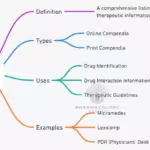
Drug compendia refer to comprehensive collections of information on drugs presented in the form of monographs. These monographs typically contain detailed descriptions of drugs, including their indications, contraindications, dosage forms, adverse effects, and storage conditions. They are essential resources for various stakeholders in the healthcare sector, including physicians, pharmacists, drug manufacturers, and regulatory authorities. Introduction … Read more

Unlock the Power of Mnemonics in Pharmacology

mnemonics in pharmacology

Discover the transformative role of mnemonics in pharmacology. Learn how these memory-enhancing tools can simplify complex drug information, making it easier to remember and apply in real-world scenarios. Introduction Pharmacology, the branch of medicine that deals with the uses, effects, and modes of action of drugs, is a vast and complex field. It’s a world … Read more

Clinical Pharmacokinetics: From Principles to Individualized Dosing

Clinical Pharmacokinetics

Clinical pharmacokinetics (PK) is the science of quantifying how drugs are absorbed, distributed, metabolized, and excreted in humans, and applying that knowledge to optimize therapy for individual patients. Its goals are to achieve target drug exposures that maximize efficacy and minimize toxicity, accounting for patient-specific factors such as organ function, age, genetics, comorbidities, and concomitant … Read more

Pharmacokinetics – What the body does to Drug?

pharmacokinetics

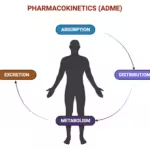
Pharmacokinetics, derived from the Greek words ‘pharmakon’ meaning drug, and ‘kinesis’ meaning movement, is the science that elucidates what the body does to a drug following administration. Pharmacokinetics is the study of how drugs move through the body. It includes processes like absorption, distribution, metabolism, and excretion (ADME), which determine how much of the drug … Read more